
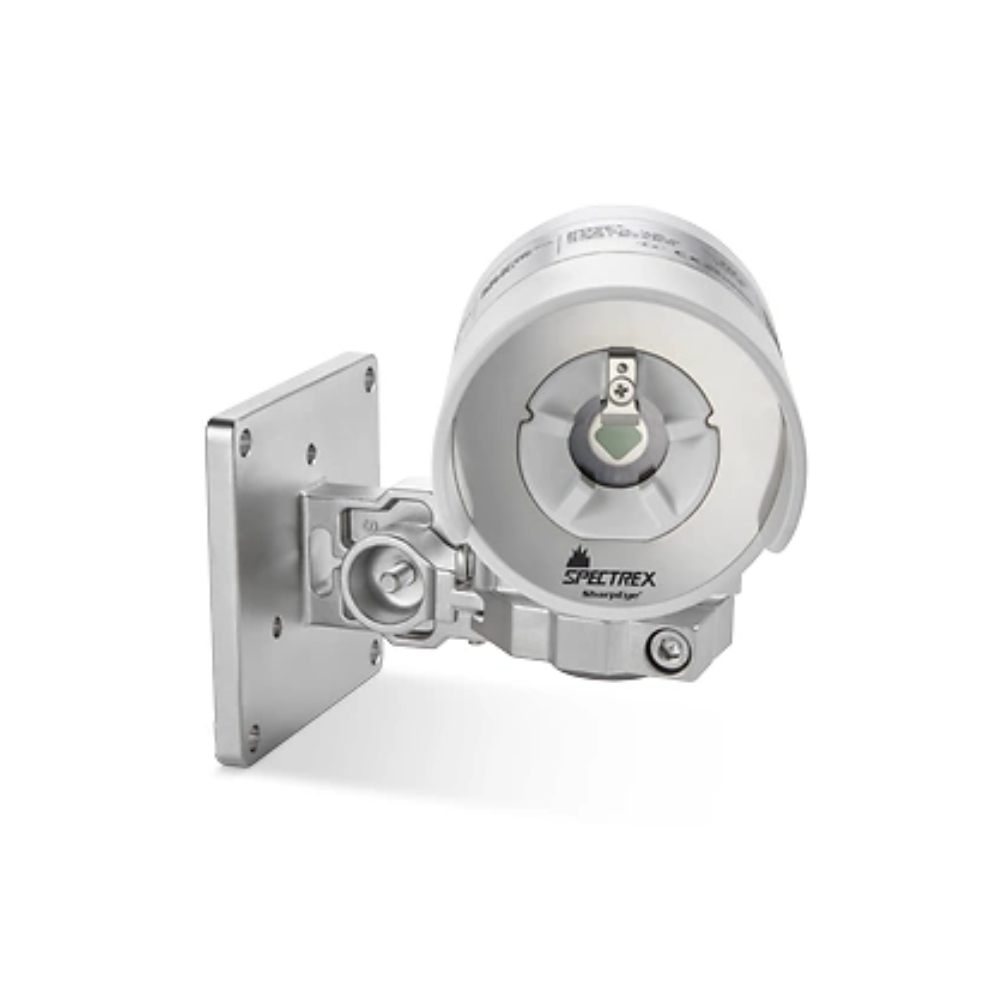
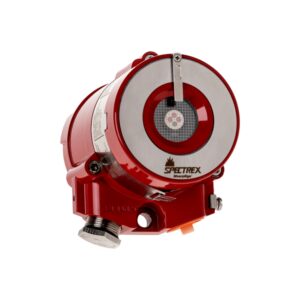
SharpEye 20/20Q
QuadSense Flame Detector
The SharpEye 20/20Q uses four infrared sensors rather than three, which is what QuadSense means and why it separates a real flame from background radiation better than an IR3 detector. It reaches 45 metres on a 0.1 square metre hydrocarbon fire, is factory calibrated for life, and carries EN 54-10 and FM performance approvals for building and light industrial fire protection. Three enclosure options include an engineered polymer version weighing 280 grams, which is the direct replacement for the 20/20MPI.
KEY BENEFITS
- Four infrared sensors across four bands, sharpening the distinction between flame and background
- Detects a 0.1 square metre gasoline fire at 45 metres, with a response typically under 5 seconds
- Factory calibrated for life, so there is no recalibration to schedule
- Five selectable sensitivity levels from 3 to 45 metres, set to suit the area
- Engineered polymer enclosure weighs 280 grams against 750 for aluminium
+ more in the Description tab below
Four Sensors, Not Three
QuadSense is the point of this detector and the name explains it.
A triple infrared detector compares three infrared bands. A real flame flickers in a characteristic way and radiates across those bands in a particular ratio. Background sources such as hot surfaces, sunlight on metal and arc welding do not match that pattern across all three at once.
The 20/20Q integrates four infrared sensors across four bands between 4 and 5 micron. The extra channel gives another point of comparison, which improves the separation between a genuine flame and background radiation that happens to resemble one.
The practical result is 45 metres on a 0.1 square metre gasoline or n-heptane fire at the highest sensitivity, with a detection response typically under 5 seconds.
Three Enclosures, One Detector
The enclosure is an ordering option rather than a different product, and the choice is about weight, cost and conditions.
| Enclosure | Weight | Suited to |
|---|---|---|
| Aluminium, M20 entry | 750 g | General installations, including where impact or abrasion is likely |
| Aluminium, connector backshell | 750 g | Where a connector rather than a gland is preferred |
| Engineered polymer, M20 entry | 280 g | Light industrial and non-corrosive environments |
The engineered polymer version is the one to understand, because the weight difference is substantial. At 280 grams against 750, it is roughly a third of the weight, and a matching polymer tilt mount weighs 120 grams against 700 for stainless steel.
On a ceiling mount, a long bracket or a retrofit onto existing structure, that difference changes what has to be engineered to support it. Emerson position the polymer enclosure for light industrial and non-corrosive environments, so it is the cost effective choice for easier conditions rather than a harsh environment option.
Where the atmosphere is corrosive, or where the detector will take knocks, aluminium is the answer.
The Direct Replacement For The 20/20MPI
The 20/20Q engineered polymer version replaces the 20/20MPI.
The important part for anyone with MPIs installed is that it uses the same wiring and the same base footprint. A detector can be swapped without rewiring, re-drilling or altering the installation.
Compared with the 20/20MPI, it brings the current 20/20Q platform, QuadSense detection, improved performance and reliability, and better false alarm immunity. If you have 20/20MPI detectors installed, talk to our Technical Consultants about planning the changeover.
Factory Calibrated For Life
Worth drawing out, because it removes a recurring cost rather than a one off one.
The detector is factory calibrated for life, so there is no periodic recalibration to schedule, budget or arrange access for. Over a fifteen or twenty year installation across a building full of detectors, that is a considerable saving in service visits.
It does not remove functional testing. The infrared built in test runs continuously and verifies the optics and the electronics, but as on any flame detector it does not fire the outputs. Proving the relays, the panel and any suppression release still needs an external flame simulator, and the FS-1100 is listed as the accessory for it.
Five Sensitivity Levels
Sensitivity is selectable at 3, 10, 20, 30 and 45 metres.
That matters more than it sounds. A detector set for 45 metres in a small plant room is watching a volume far larger than the area it protects. That gives more opportunity for a distant background source to be seen. Setting the sensitivity to the area actually being covered improves false alarm performance rather than degrading protection.
An internal event log recorder holds the history, which is what you need when investigating why a detector alarmed or faulted three weeks ago.
Outputs And Integration
Three output paths are available together. Relays for fault and alarm, rated 2 amps at 30 volts DC. A stepped 0 to 20 milliamp output, configurable, with distinct levels for fault, built in test fault, normal, warning and alarm. And RS-485 Modbus for integration into a controlled installation.
The stepped current output is the useful one for retrofit, because a single pair of wires carries five distinguishable states back to a panel.
Supply is 24 volts DC nominal across a 12 to 32 volt range, drawing 25 milliamps and 0.6 watts in normal operation. Universal wiring is offered as an ordering option to simplify specification.
Where It Is Used
Emerson’s own application list is worth reading as written, because it describes a building fire detector rather than a process one.
Airport terminals. Train stations and terminals. Storage areas and archives. Shopping centres. Hospitals. Car parking towers and garages. Public buildings. Banks and offices. Historical and cultural sites. Aircraft hangars. Cable tunnels. Automotive parts manufacturing.
For a classified area, the SharpEye 40/40 range carries hazardous area approval and reaches considerably further.
Detection Ranges
At the highest sensitivity setting, for a 0.1 square metre pan fire.
| Fuel | Range |
|---|---|
| Gasoline | 45 m |
| N-heptane | 45 m |
| Butyl acrylate | 37 m |
| Vinyl acetate | 37 m |
| Solvents | 37 m |
| JP5 | 32 m |
| Kerosene | 32 m |
| Jet A1 | 32 m |
| Diesel fuel | 32 m |
| Methane | 32 m |
| Liquefied petroleum gas | 32 m |
| Cooking oil | 32 m |
| Mineral oil 20W-50 | 32 m |
| Oil 10W-40 | 32 m |
| Oil paint | 32 m |
| Flammable adhesive, flash point below 60 °C | 32 m |
| Ethanol 95% | 30 m |
| Isopropyl alcohol | 30 m |
| Methanol | 30 m |
| Gun powder | 30 m |
| Ethylene glycol | 25 m |
| Polypropylene | 25 m |
| Paper | 17 m |
| Wood | 17 m |
| Fireworks, ten pieces per test | 5 m |
Methane and LPG figures are for a 0.75 metre high, 0.25 metre wide plume fire.
Benefits
- Four infrared sensors across four bands, sharpening the distinction between flame and background
- Detects a 0.1 square metre gasoline fire at 45 metres, with a response typically under 5 seconds
- Factory calibrated for life, so there is no recalibration to schedule
- Five selectable sensitivity levels from 3 to 45 metres, set to suit the area
- Engineered polymer enclosure weighs 280 grams against 750 for aluminium
- Direct replacement for the 20/20MPI, using the same wiring and base footprint
- EN 54-10 and CPR certified, with Class 1 sensitivity at 20, 30 and 45 metres
- Infrared built in test continuously verifies the optics and electronics
- Internal event log recorder for investigating an alarm or a fault after the fact
- Rated lifespan of 150,000 hours, with a two year warranty
Detection principle
QuadSense, four infrared sensors across four bands between 4 and 5 micron
Detection range
Up to 45 m on gasoline and n-heptane at highest sensitivity
Response time
Typically under 5 seconds
Sensitivity levels
Five, selectable at 3, 10, 20, 30 and 45 m
Field of view
100 degrees horizontal, 95 degrees vertical, at 50 percent of maximum distance
Calibration
Factory calibrated for life
Built in test
Infrared BIT, continuous verification of optics and electronics
Event log
Internal log event recorder
Operating temperature
Minus 40 to plus 70 °C
Storage temperature
Minus 40 to plus 70 °C
Humidity
Up to 100 percent relative humidity, non-condensing
Operating voltage
24 V DC nominal, 12 to 32 V DC
Power consumption
25 mA, 0.6 W at 24 V DC in normal operation
Relay outputs
Fault normally closed, alarm normally open. SPST volt free, 2 A at 30 V DC
Analogue output
0 to 20 mA stepped and configurable. Fault below 1.1 mA, BIT fault 2 mA, normal 4 mA, warning 16 mA, alarm 20 mA
Digital output
RS-485 Modbus compatible
Cable entry
One M20, or connector backshell depending on enclosure
Electrical interface
Nine terminals, single cable conduit
Dimensions
108 x 80 x 118 mm
Weight, aluminium
750 g
Weight, engineered polymer
280 g
Tilt mount weight
700 g stainless steel, 120 g engineered polymer
Enclosure rating
IP66 and IP68, UL50E Type 4X, EN 60529, NEMA 250 6P
Hazardous area approval
Non-hazardous areas
Performance approvals
FM3260, EN 54-10, ULC/ORD-C386-15. DNV available as an ordering option
EN 54-10 classification
Class 2 at 10 m. Class 1 at 20, 30 and 45 m
CPR certificate
2809-CPR-E0040
Lifespan
150,000 hours
Warranty
Two years
Electromagnetic compatibility
EN 61000-6-3, EN 61000-6-4, EN 61000-6-6 and EN 50130
- Aviation & Transportation
- Carpark & HVAC
- Food & Beverage
- Marine & Maritime
- Medical & Healthcare
- Power Generation & BESS
- Technology & Semiconductor
Four infrared sensors across four bands rather than three, which gives the detector another point of comparison and sharpens the distinction between a real flame and background radiation.
No. The hazardous area approval option is non-hazardous areas only. For a classified area the SharpEye 40/40 range carries hazardous area approval and reaches considerably further.
Light industrial and non-corrosive environments. It weighs 280 grams against 750 for aluminium, which matters on ceiling mounts, long brackets and retrofits. For corrosive atmospheres or where impact is likely, choose aluminium.
Yes. The engineered polymer version is the direct replacement, using the same wiring and the same base footprint, so a detector is swapped without rewiring or re-drilling.
No. It is factory calibrated for life. Functional testing with a flame simulator is still required, since the built in test does not fire the outputs.
Set it to the area actually being protected. A detector set for 45 metres in a small room is watching a far larger volume than it needs to, which gives more opportunity to see a distant background source.
Trusted by









Contact Us
Can’t find what you’re looking for? Our team is happy to help.