
testo 380
Fine Particle Measuring System
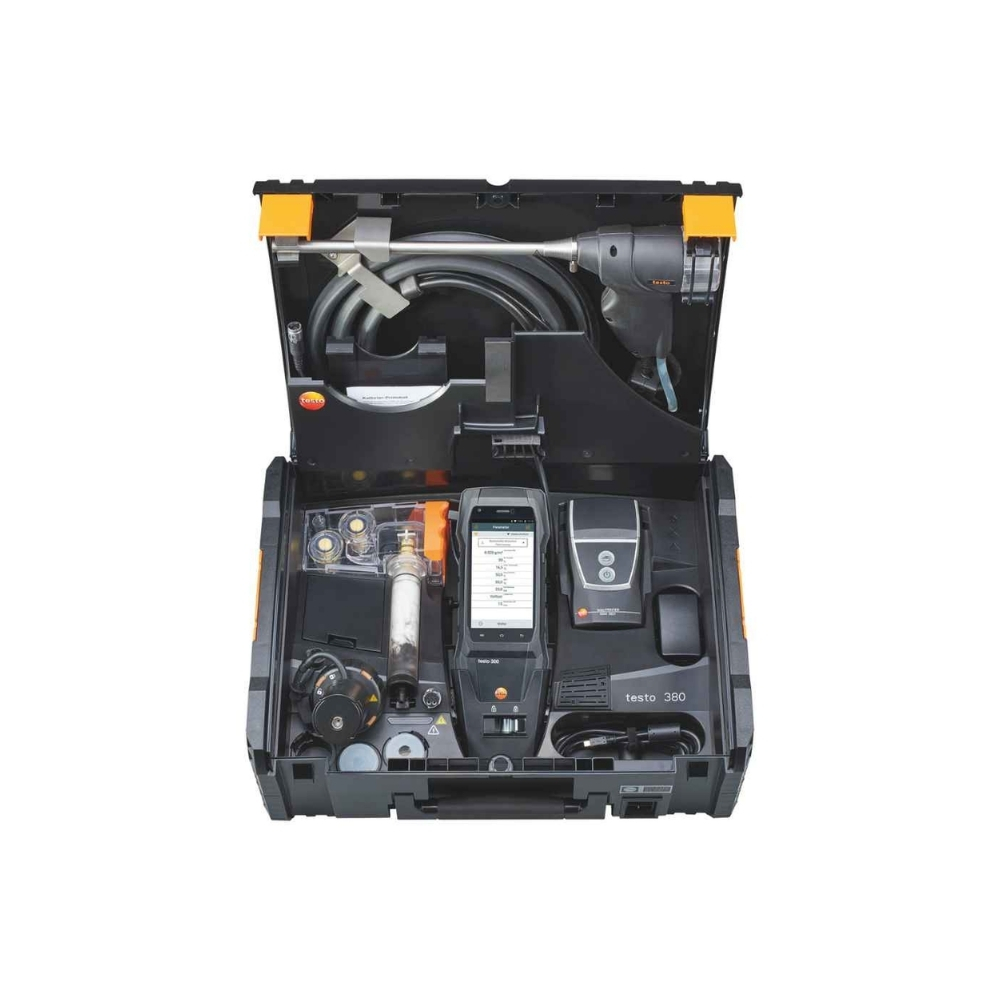
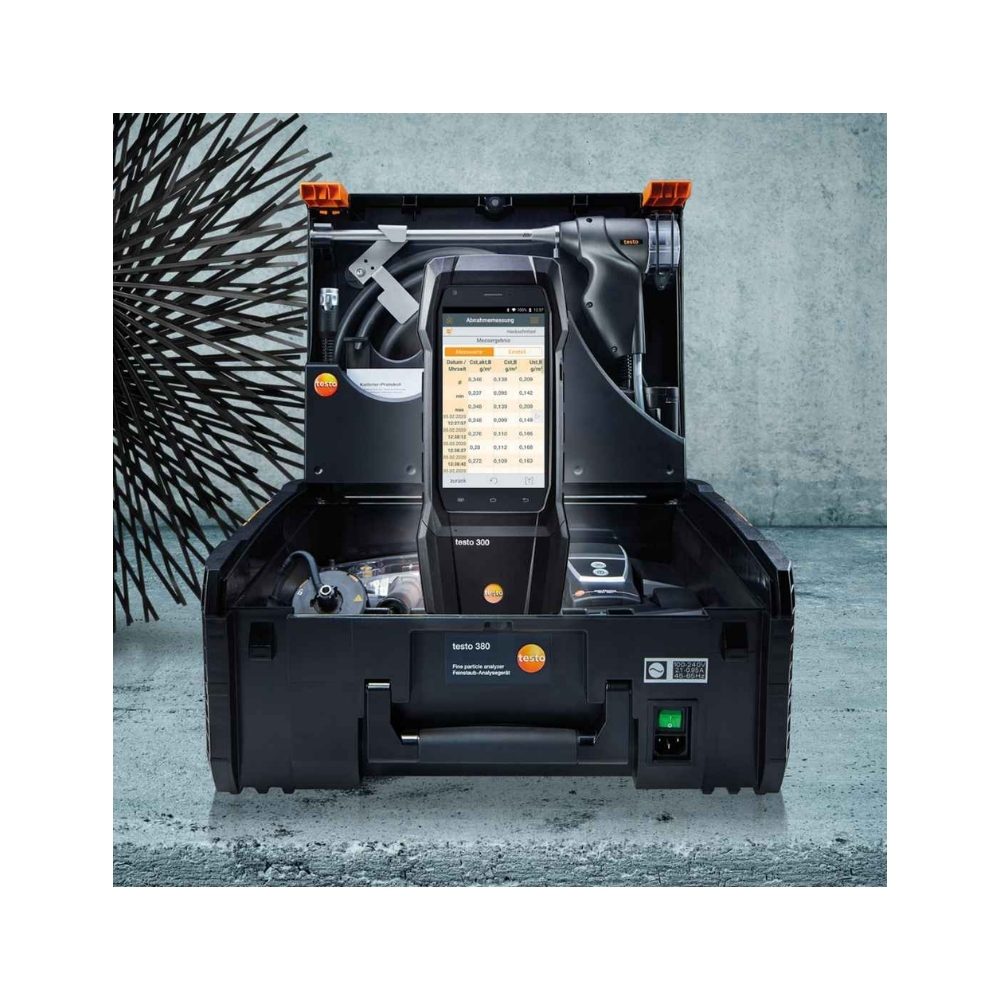
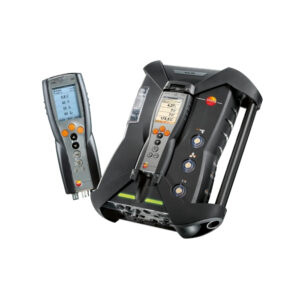
The testo 380 measures fine particulate directly in flue gas, alongside oxygen and carbon monoxide, in real time. It’s a two part system: the testo 380 fine particle analyser and probe, paired with a testo 330-2 LL flue gas analyser, which acts as the control centre. Built for solid fuel, oil and gas fired systems, it removes the wait for laboratory analysis by giving a result on site.
KEY BENEFITS
- Measures fine particulate, oxygen and carbon monoxide in parallel and in real time
- Gives a result on site, so adjustments are made against measured data rather than an estimate
- Approved for solid fuels, oil and gas, covering fuel groups 1 to 8 under VDI 4206 Sheet 2
- Probe shaft heated to 120°C to prevent condensation and protect sample integrity
- Patented ceramic rotation diluter built into the probe, keeping contamination to a minimum
+ more in the Description tab below
A System, Not an Instrument
It’s worth understanding this before comparing it to anything else, because it changes what you’re buying.
The testo 380 has two components. The testo 380 fine particle analyser, with its fine particle probe, does the particulate measurement. A testo 330-2 LL flue gas analyser sits alongside it as the control centre, and handles the oxygen and carbon monoxide measurement. The testo 380 must be used with the testo 330-2 LL, and the 330-2 LL can also be taken out of the case and used on its own for flue gas analysis on oil and gas systems.
Together, they measure particulate, oxygen and carbon monoxide in parallel, and display all of it in real time. That parallel measurement is the point. Particulate alone tells you the emission. Particulate alongside oxygen and carbon monoxide tells you why, because incomplete combustion is what produces the particulate in the first place.
Particulate Measurement Is Normally a Laboratory Job
This is the argument for the system, and it’s about workflow rather than technology.
Traditional particulate measurement means collecting a sample on site, sending it away and waiting for the result. By the time it arrives, the technician has left, and any adjustment has already been made on judgement rather than data.
The testo 380 gives the result on site, in real time. The effect of any change to the boiler shows on the display straight away, so a solid fuel system can be adjusted, measured again and confirmed within one visit. On commissioning or optimisation work, that’s the difference between tuning a system and guessing at it.
An official measurement takes about 30 minutes, and a tightness test of the measurement system is needed beforehand.
The Probe Does the Difficult Part
Particulate measurement in flue gas is hard for two reasons, and both are handled in the probe.
The first is condensation. Flue gas is hot and wet. If it cools in the sampling path, moisture condenses and takes particulate with it, so the sample reaching the instrument isn’t the one that entered the probe. The probe shaft is heated to a constant 120°C to prevent that.
The second is concentration. Raw flue gas particulate can be well outside what a measuring instrument can handle directly. A patented rotation diluter, made of technical ceramics and heated to 80°C, is built into the probe. It mixes the raw gas with a defined amount of fresh air, which keeps contamination of the gas paths and the whole system to a minimum.
The fine particle sensor then measures the mass of the particles directly. The particles land on an oscillating sensor, and the change in its frequency gives the particle mass, fast enough to show readings in real time.
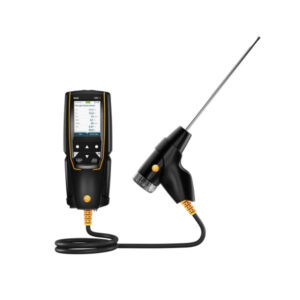
One probe handles sampling, temperature, draught, heating and dilution, so no other probes are needed for fine particle measurement.
Cleaning and Maintenance
This is a small point, but it matters on an instrument handling soot.
Because the rotation diluter keeps contamination to a minimum, cleaning is done with conventional household cotton buds. No specialist cleaning kit is needed. Testo describes the system as particularly economical to operate and maintain.
Certification and Its Origin
The system is TÜV tested for limit value levels 1 and 2, and to VDI 4206 Sheet 2. It’s approved for fuels in instrument classes A, B and C of VDI 4206-2, which covers fuel groups 1 to 8: coal, lignite, peat, natural wood in all forms, wood briquettes and pellets, treated and glued wood, and straw and other plant materials.
Those references come from the German regulatory framework, specifically the first German Federal Emission Control Ordinance (1st BImSchV), which sets particulate limits for solid fuel systems. The instrument has pre saved measurement menus and step by step guidance for those procedures.
Australia has no direct equivalent, so here the certification shows measurement capability and traceability, rather than meeting a local legal requirement. That’s worth knowing when specifying: the measurement is sound, but the compliance framework is German.
Where It’s Used
Solid fuel fired boilers and heating systems. Biomass and wood pellet plant. Wood chip fired systems. Oil fired heating plant. Gas fired systems where particulate is a concern. Commissioning and optimisation of solid fuel combustion. Service and inspection work on solid fuel appliances. Emissions checks where a laboratory turnaround isn’t practical.
Benefits
- Measures fine particulate, oxygen and carbon monoxide in parallel and in real time
- Gives a result on site, so adjustments are made against measured data rather than an estimate
- Approved for solid fuels, oil and gas, covering fuel groups 1 to 8 under VDI 4206 Sheet 2
- Probe shaft heated to 120°C to prevent condensation and protect sample integrity
- Patented ceramic rotation diluter built into the probe, keeping contamination to a minimum
- Graphical display of all measured values for a single view of system performance
- One probe handles sampling, temperature, draught, heating and dilution
- Easy cleaning with ordinary cotton buds, no special equipment
- Measures 0 to 300 mg/m³ with 0.1 mg/m³ resolution, TÜV tested for limit value levels 1 and 2
- Low operating and maintenance cost relative to laboratory analysis
Instrument type
Portable fine particle measuring system
System components
testo 380 fine particle analyser with fine particle probe, plus a testo 330-2 LL flue gas analyser as control centre (330-2 LL/F or 330-2 LL V2010)
Measured parameters
Fine particulate mass concentration, oxygen, carbon monoxide, flue gas temperature, draught
Measurement
Parallel and in real time
Displayed values
PM mean value since start of measurement, and averaged end result
Sampling path
Probe shaft heated to 120°C, to prevent condensation
Dilution
Patented ceramic rotation diluter, heated to 80°C, integrated in the fine particle probe
Display
Large colour graphical display
Fuels covered
Solid fuel, oil and gas fired systems. Suitability approval for fuels 1 to 8
Measurement duration
Approximately 30 minutes for an official measurement
Pre-measurement check
Tightness test of the measurement system required before an official measurement
Certification
TÜV tested for limit value levels 1 and 2, and to VDI 4206 Sheet 2
Standards compliance
EN 61010-1 and EN 50270
Cleaning
Conventional household cotton buds, no special equipment
Measurement programmes
Pre-saved menus with step by step guidance, plus adjustment programmes for solid fuel systems
Measuring range
0 to 300 mg/m³. Resolution 0.1 mg/m³ (above 5 mg/m³). Accuracy to VDI 4206-2
Memory
500,000 readings
Fine particle probe
270 mm long, 12 mm stainless steel shaft, 2.2 m cable. Flue gas temperature up to 500°C. LED status display
Weight and dimensions
testo 380 system case: 7.9 kg, 475 x 360 x 190 mm. testo 330-2 LL: 0.65 kg
Power
Internal mains unit, 100 to 240 V AC, 50 to 60 Hz. Maximum 100 W
Operating conditions
+5 to +40°C. IP40
Carbon Monoxide
CO
Oxygen
O2
- Food & Beverage
- Power Generation & BESS
No, it's a two part system. The testo 380 fine particle analyser and probe handle the particulate, and a testo 330-2 LL flue gas analyser acts as the control centre and measures oxygen and carbon monoxide.
Fine particulate mass concentration from 0 to 300 mg/m³, plus oxygen, carbon monoxide, flue gas temperature and draught, in parallel and in real time.
Because incomplete combustion is what produces particulate. Measuring all three together tells you why the particulate is there rather than only that it is.
Flue gas is hot and wet. If it cools in the sampling path the moisture condenses and takes particulate with it, so the sample reaching the instrument no longer represents what entered the probe.
Around 30 minutes for an official measurement, with a tightness test of the system required beforehand.
The Testo 380 measures fine particulate in flue gas from combustion systems. The DPM-RT 2 measures diesel particulate at the exhaust pipe of engines and vehicles. Different sources, different applications.
Trusted by









Contact Us
Can’t find what you’re looking for? Our team is happy to help.