
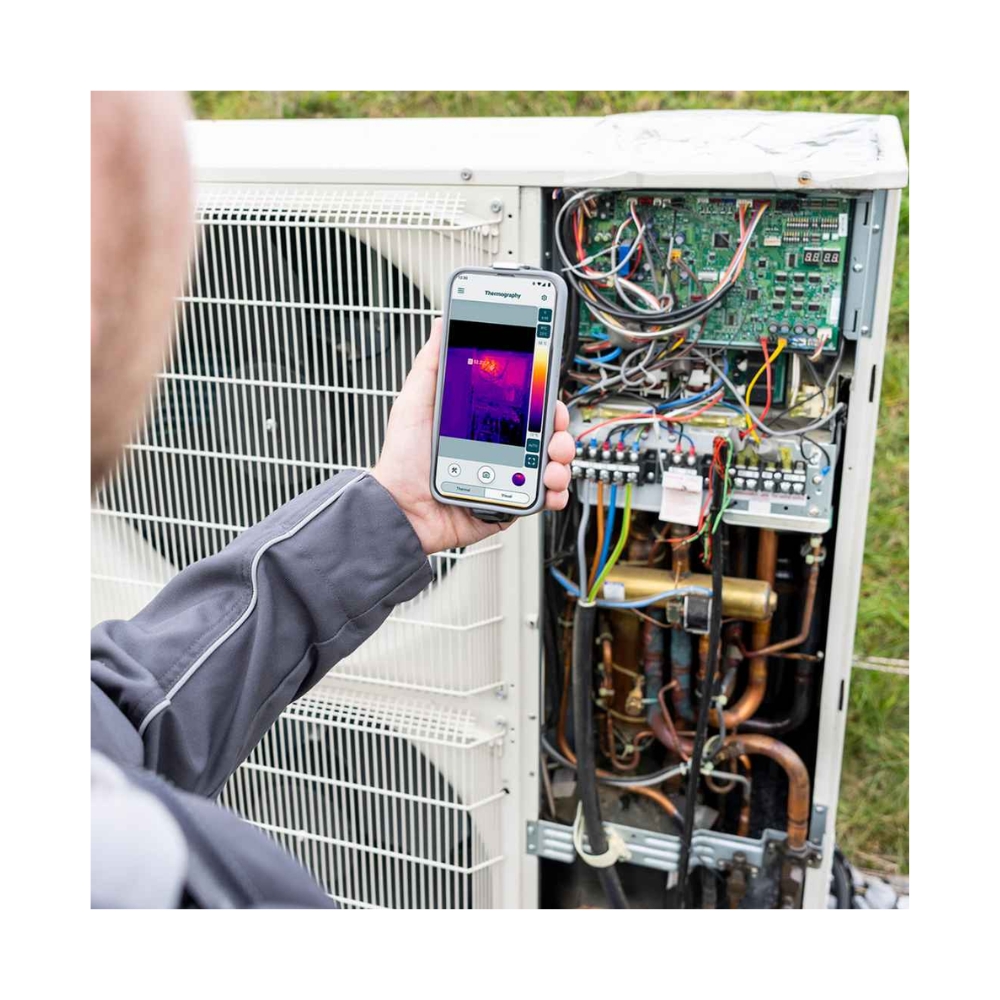
testo 860i
Wireless Thermal Imager
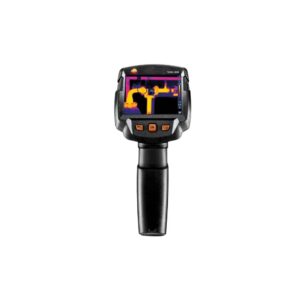
The Testo 860i has no screen. Your phone is the display, which is what keeps the camera small enough to clip onto the phone itself or hold in one hand. A 256 by 192 detector gives 49,152 pixels, thermal sensitivity is 0.05 degrees, and the Delta functions are built around measuring the difference between two points rather than an absolute temperature. It is the entry point to thermal imaging, aimed at spot checks rather than documented surveys.
KEY BENEFITS
- Your phone is the display, so the camera stays small and the image is where you are
- 256 x 192 infrared resolution, giving 49,152 temperature points for sharp thermal images
- Thermal sensitivity of 0.05 degrees Celsius, so small differences show up
- DeltaHeat reads flow and return temperatures on heating plant and suggests causes
- DeltaCool establishes differential temperature on refrigeration and air conditioning
+ more in the Description tab below
The Phone Is the Display
This is the design decision the whole camera follows from, and it’s the same approach Testo takes with the testo 915i temperature probe.
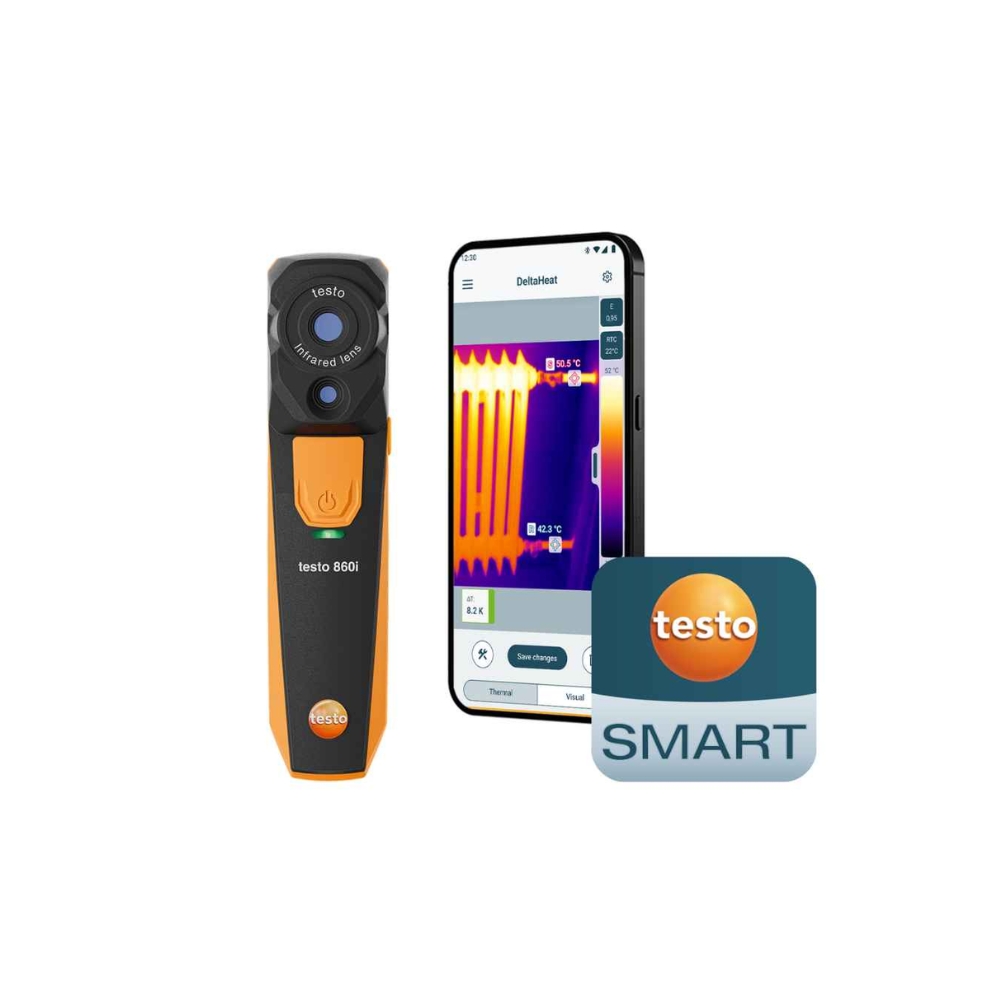
The 860i has no screen and no keypad. It connects to the free testo Smart App over WiFi and Bluetooth, and the app becomes the display, the controls and the reporting tool.
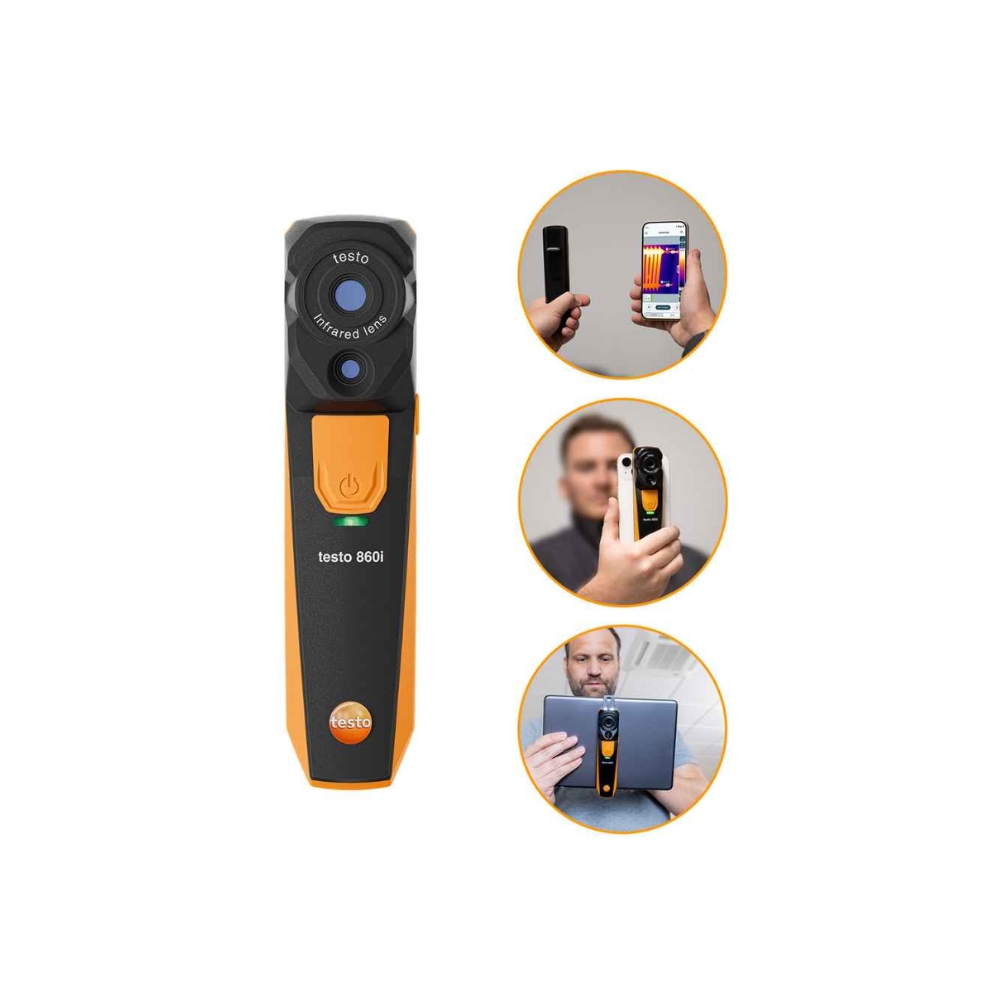
That removes most of the bulk. At 195 grams, the camera clips directly onto a phone or tablet, putting the thermal image and the visible scene in the same hand. It also works on its own, controlled from the phone at up to 10 metres away.
It also means the reporting happens where the measurement does. A thermal survey is as much about documentation as measurement, and creating the record on the phone at the time avoids copying images and readings later. Images can be shared straight away, or sent as a PDF report.
The app needs iOS 17 or later, or Android 14 or later, with Bluetooth 4.0.
Built Around Delta T, Not Absolute Temperature
It’s worth understanding, because it explains both the strength and the limitation of this camera.
Accuracy is ±3°C or ±3% of reading. For an absolute measurement against a threshold, that’s a meaningful uncertainty. For a differential measurement, it matters far less. Both points are read by the same detector under the same conditions, so much of the error cancels, and the difference is more reliable than either number alone.
The 860i is designed around that, with three application specific functions.
DeltaHeat quickly shows the spread between flow and return temperatures on radiators and heating plant.
DeltaCool quickly establishes the temperature difference in refrigeration and air conditioning systems.
Humidity mode helps assess the risk of mould indoors. Readings from an optional testo 605i or testo 625 thermohygrometer transfer automatically to the app.
So the honest way to think about it is a camera for finding what’s hotter or colder than it should be, relative to something else. That covers a lot of practical inspection work, but it isn’t the instrument for certifying an absolute temperature against a limit.
Analysis Functions
Hot and cold spot detection finds the extremes in the image automatically.
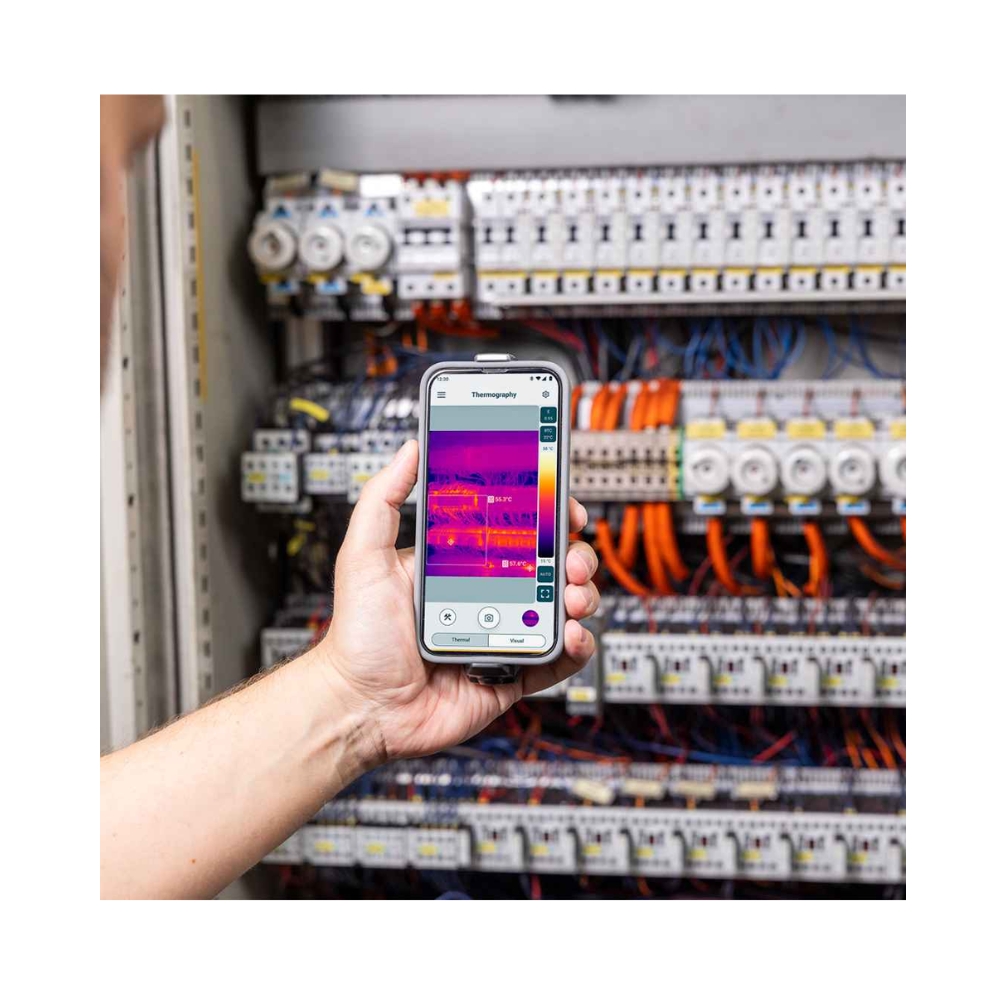
Up to ten individual measuring points can be selected, which suits comparing several terminals in a switchboard, or several panels in a string, in one image.
Area measurement gives the minimum and maximum across a selected region, which is the right tool where the target is a surface rather than a point.
For electrical work, readings from the optional testo 770-3 clamp meter transfer to the app automatically, or current, voltage and power can be entered by hand.
The display switches between the infrared image and the real image from the 640 x 480 visual camera. Eleven colour palettes are available, including iron, rainbow, cold-hot, grey, sepia and a dedicated humidity palette for damp and mould work.
Fixed Focus, and What That Means for Range
Two specifications work together here, and they set the practical limits.
The lens is fixed focus, with a 48° x 36° field of view and a minimum focus distance of 0.3 metres. There’s no focus adjustment, so the image is sharp within a range and can’t be optimised for a distant target.
Geometric resolution is 3.3 milliradians, which means one pixel covers about 3.3 millimetres at one metre, and 33 millimetres at ten metres. A reliable temperature needs the target to cover several pixels, so a hot spot ten metres away needs to be roughly 100 millimetres across before the reading can be trusted.
That isn’t a criticism. It’s the selection question. A terminal at arm’s length in a switchboard, a radiator, a coil or a wall is well within range. A connection at height, a panel on a roof seen from the ground, or a busbar behind a barrier needs a camera with more capability.
Where It Sits in the Range
The 860i is Testo’s thermal imager for quick spot checks in HVAC, maintenance and building work.
Fixed focus, ±3°C accuracy, a 9 Hz frame rate and a two hour battery suit that work. For a technician who wants a thermal camera in the van and uses it a few times a week, it’s the right instrument.
Where the output is a formal thermographic survey with absolute temperatures, or the targets are small and distant, the testo 868, testo 872 and testo 883 step up in capability. Our Technical Consultants can help you choose.
Built for the Van
IP54 protection and drop testing to 1.5 metres suit an instrument that lives in a vehicle, not an office.
The built in lithium ion battery runs for about two hours, which is enough for a working session rather than a full day. It charges over USB-C in about 90 minutes, and a 15 minute charge gives 30 minutes of use. That’s worth knowing when planning a large survey.
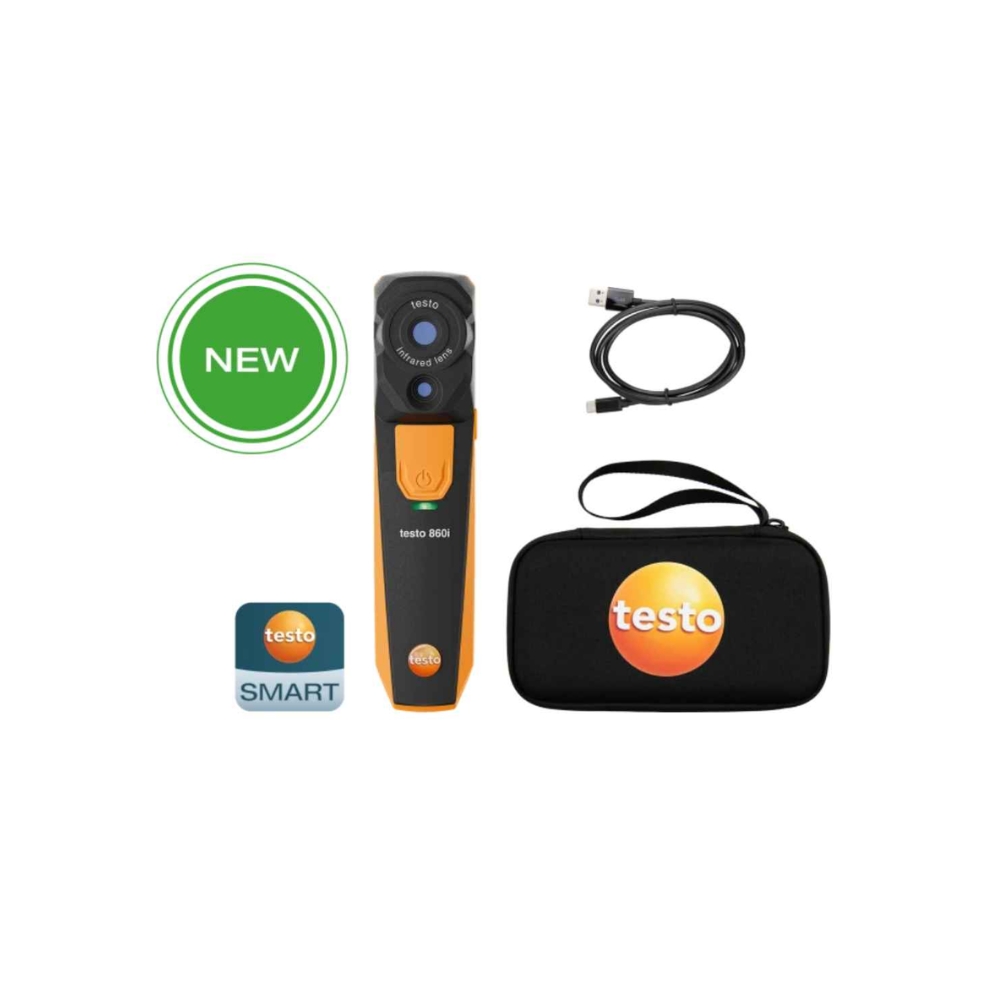
The testo 860i kit includes a bag for safe transport and a USB-C cable.
Where It’s Used
HVAC commissioning and fault finding. Refrigeration and air conditioning checks. Heating plant flow and return checks. Electrical inspection of switchboards and distribution boards at close range. Motor and bearing checks. Damp, mould and insulation assessment in buildings. Underfloor heating tracing. Blocked pipe and radiator diagnosis. General maintenance and service work. Quick spot checks where a full survey isn’t warranted.
Benefits
- Your phone is the display, so the camera stays small and the image is where you are
- 256 x 192 infrared resolution, giving 49,152 temperature points for sharp thermal images
- Thermal sensitivity of 0.05 degrees Celsius, so small differences show up
- DeltaHeat reads flow and return temperatures on heating plant and suggests causes
- DeltaCool establishes differential temperature on refrigeration and air conditioning
- Up to ten individual measuring points, plus area minimum and maximum
- Clips directly to a phone or tablet, or works one handed on its own
- Humidity mode helps assess mould risk, with readings from an optional Testo thermohygrometer
- IP54 and drop tested to 1.5 metres, at just 195 grams
- Documentation created and shared from the app rather than written up later
Instrument type
Wireless thermal imager operated through a smartphone or tablet
Display
None on the camera. Phone or tablet running the Testo Smart App
Infrared resolution
256 x 192 pixels, 49,152 pixels total
Thermal sensitivity
0.05 °C, 50 mK
Measuring range
Minus 20 to plus 350 °C
Accuracy
±3°C or ±3% of reading (ambient -10 to +40°C, scene 0 to +150°C or +100 to +350°C)
Frame rate
9 Hz
Focus
Fixed
Minimum focus distance
0.3 m
Geometric resolution, IFOV
3.3 mrad
Measurement functions
Delta T. DeltaHeat (heating flow and return), DeltaCool (refrigeration and air conditioning), humidity mode (mould risk)
Analysis
Hot and cold spot detection, up to ten individual measuring points, area minimum and maximum
Display options
Infrared image or real image
Colour palettes
Eleven, including iron, rainbow, rainbow HC, cold-hot, blue-red, grey, inverted grey, sepia, Testo, iron HT and humidity
Connectivity
WiFi (IEEE 802.11b/g/n) and Bluetooth to the testo Smart App. Remote operation up to 10 m
App requirements
iOS 17 or later, or Android 14 or later, with Bluetooth 4.0
Mounting
Clips to a phone or tablet (clip span 120 to 170 mm, device depth up to 12 mm), or used separately. 1/4 inch tripod socket
Battery
Rechargeable lithium, approximately 2 hours operating time
Charging
USB-C. About 90 minutes. 15 minute charge gives 30 minutes of use
Ingress protection
IP54
Drop protection
Tested to 1.5 m
Versions
testo 860i kit, with transport bag and USB-C cable
Field of view
48° x 36°
Spectral range
8 to 14 µm
Emissivity
0.01 to 1, manual adjustment in the app, with reflected temperature
Visual camera
640 x 480 pixels, minimum focus 0.4 m
Connected instruments
Optional testo 605i or testo 625 thermohygrometer (humidity mode). Optional testo 770-3 clamp meter (electrical mode)
File formats and software
.bmt (for testo IRSoft), .jpg and .csv. testo IRSoft PC software (Windows 10 and 11)
Weight and dimensions
195 g. 165 x 45 x 38 mm
Operating conditions
-10 to +50°C. 5 to 95% RH, non condensing
- Aviation & Transportation
- Carpark & HVAC
- Chemical Manufacturing
- Energy (Oil & Gas)
- Food & Beverage
- Landfill & Remediation
- Medical & Healthcare
- Mining & Minerals
- Power Generation & BESS
- Technology & Semiconductor
- Water & Wastewater
No. It connects over Bluetooth and WiFi to the Testo Smart App on a phone or tablet, and the app is the display, the controls and the reporting tool.
256 by 192 pixels, which is 49,152 pixels in total.
DeltaHeat quickly shows the spread between flow and return temperatures on radiators and heating plant. DeltaCool quickly establishes the temperature difference in refrigeration and air conditioning systems. A third function, humidity mode, helps assess mould risk.
±3°C or ±3% of reading. That matters for an absolute measurement against a threshold, and much less for a differential measurement, where both points are read by the same detector.
Geometric resolution is 3.3 milliradians, so one pixel covers about 33 millimetres at ten metres. A reliable temperature needs the target to cover several pixels, so a hot spot at that distance should be around 100 millimetres across.
No, the lens is fixed focus, with a minimum distance of 0.3 metres. For distant or small targets, talk to our Technical Consultants about the higher models in the Testo range.
Trusted by









Contact Us
Can’t find what you’re looking for? Our team is happy to help.